Moon Cities May Run Out of Water in 100 Years
A new study challenges the timeline for large-scale lunar settlements by highlighting a severe shortage of accessible water resources.
By Mei Lin ·
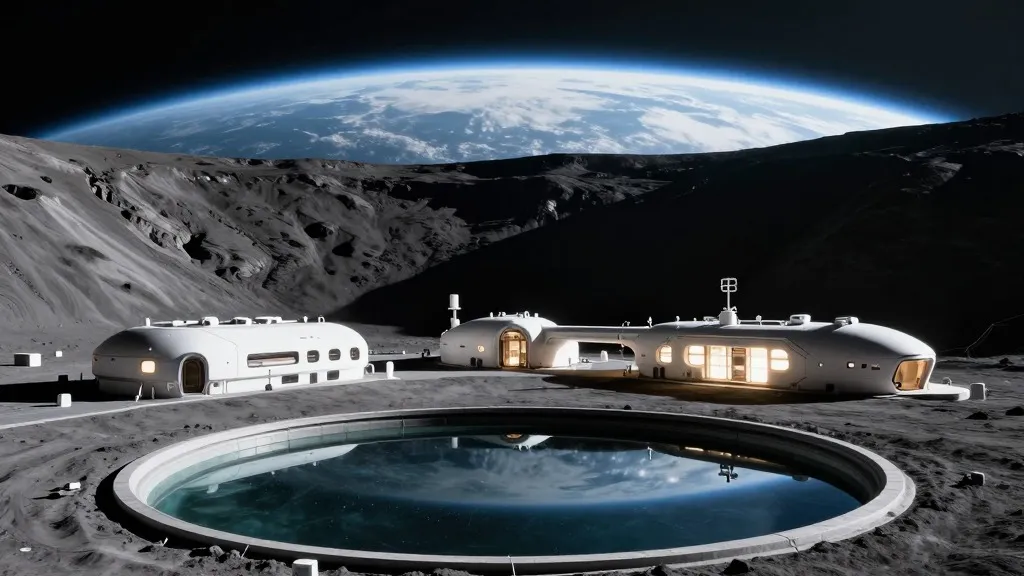
One hundred years. That is the estimated lifespan of a lunar city supporting one million people, according to a new analysis published in Frontiers in Space Technologies. The finding stands in sharp contrast to the ambitious timelines proposed by major space industry leaders who envision rapid colonization of the moon. While solar and nuclear power sources appear sufficient to sustain such a population, the availability of water presents a more significant hurdle for long-term habitation.
The debate over the feasibility of lunar cities has intensified following recent public statements from tech executives. In February, Elon Musk, CEO of SpaceX, announced on social media that the company had shifted its primary focus from Mars to building a self-growing city on the moon. Musk suggested this goal could be achieved in under ten years, a timeframe he considered faster than the more than 20 years required for Mars. Jeff Bezos, CEO of Blue Origin, has made similar bold predictions, claiming that millions of people will be living in space by 2045.
Martin Elvis, a senior astrophysicist at the Harvard-Smithsonian Center for Astrophysics, and Jonathan McDowell, an honorary professor at the Durham University Space Research Centre in England, decided to examine these claims through a data-driven lens. Their research focuses on two critical resources for survival: power and water. The team found that energy generation is not the limiting factor. Current technologies, including solar and nuclear options, would provide enough electricity to support a million-person settlement on the lunar surface without major strain.
Water, however, tells a different story. Most of the moon's water is believed to exist in permanently shadowed regions at the poles, areas that sunlight never reaches. Current estimates suggest the moon contains roughly one billion tonnes of this water. Based on this figure and assuming a recycling rate of 98 percent, similar to that achieved on the International Space Station, the researchers calculated that a population of one million would exhaust the supply in approximately a century. If the actual amount of accessible water is lower, the timeline shrinks dramatically.
Elvis provided a visual comparison to illustrate the scale of the resource. He described the estimated water supply as equivalent to an aquarium the size of Central Park filled until the Statue of Liberty was just underwater. He noted that while the total volume sounds large in isolation, it is modest when considered against the needs of a major urban center. A small lake, he argued, is not sufficient to supply a big city for very long.
Smaller settlements face less pressure. The study indicates that a town of 10,000 people could remain sustainable for centuries under the same assumptions. McDowell pointed out that if humanity intends to cover the moon with cities as depicted in science fiction, a new method must be found to transport water to the surface. He emphasized that the resource is not currently in a state that easily supports widespread urban development.
The researchers also questioned the generosity of the initial estimates. Elvis suggested that the one billion tonne figure might be 20 or 30 times too large. He further noted that only one-third to one-half of the existing water would likely be recoverable. His best guess is that the usable amount is about one percent of the original figure, which would reduce the 100-year lifespan to just one year. Gordon Osinski, a professor of planetary geology at Western University in London, Ontario, added that satellite measurements carry uncertainties. He believes the water is present but needs on-ground confirmation. He suggested it may resemble Arctic permafrost, consisting of sub-millimetre ice crystals mixed into soil that are difficult to extract.
Despite the constraints, the researchers do not view the findings as a reason to abandon the effort. McDowell stated that the truth is never negative. He argued that the only negative outcome is attempting to execute a plan that is not going to work. The data suggests that while large-scale lunar cities may face resource bottlenecks, smaller, more measured approaches could still be viable in the coming decades.
Source: CBC News